If you build AI agents, APIs, or MCP servers, you probably want to get paid when other machines consume your tools. But traditional payment gateways introduce a big catch: they hold onto your money in their own bank accounts, lock your funds behind withdrawal schedules, and take control of your earnings.
With PayAgents Non-Custodial Direct Receiving, you can now receive payments from AI agents straight into your personal crypto wallet or Lightning node. PayAgents verifies that the payment was made, unlocks your API, and never touches a single cent of your money.
In this guide, we'll explain what "non-custodial" means in simple terms, why it's a game-changer for the machine economy, and how you can turn it on in your PayAgents dashboard in less than two minutes.
1. Custodial vs. Non-Custodial: A Simple Analogy
To understand the difference, imagine selling a digital service in the real world:
The Custodial Model (Traditional)
A customer pays the platform cashier. The platform puts the cash in their own corporate vault and gives you an "IOU" note on your screen. You have to ask the platform for permission to withdraw your earnings, often waiting days for bank transfers or payout thresholds.
The Non-Custodial Model (PayAgents)
The paying agent transfers the money directly into your personal wallet. PayAgents simply acts as the validator who checks that the exact payment arrived before granting access to your API. Your money never enters PayAgents' custody.
2. Why Non-Custodial Is Better for API Builders
- Zero Counterparty Risk: You don't have to trust any third party with your revenue. Your funds cannot be frozen, withheld, or subject to unexpected platform restrictions.
- Instant Liquidity: Money is in your hands the exact second the transaction finishes. You can spend it, reinvest it, or convert it immediately.
- Global & Permissionless: Anyone anywhere in the world can monetize their AI services without needing traditional merchant banking infrastructure or paperwork.
- True Ownership: Self-custody means your keys, your coins. You stay in 100% control of your business income.
3. How Direct Payments Work Across the Two Rails
PayAgents supports non-custodial receiving across both major autonomous machine payment standards:
| Payment Rail | Asset Used | How Direct Settlement Works |
|---|---|---|
| x402 (Base Chain) | USDC Stablecoin | The AI agent signs an on-chain transfer permit directly to your Ethereum/Base wallet address. The transfer executes on Base mainnet straight to you. |
| L402 (Lightning) | Bitcoin (Sats) | PayAgents asks your Lightning node (via LNURL-pay) to generate a fresh invoice. The AI agent pays your node directly, and PayAgents checks the secret payment preimage to verify delivery. |
4. How to Configure Direct Receiving in 2 Minutes
Setting up non-custodial payments in PayAgents is completely straightforward:
Step-by-Step Setup Guide
Log into the PayAgents Dashboard and navigate to Settings.
Paste your 42-character Ethereum/Base
wallet address (e.g. 0x1234...5678 from Coinbase Wallet, MetaMask, or Rainbow).
Enter your Lightning Address (e.g.
you@getalby.com, merchant@blink.sv, or your self-hosted node address).
That's it! Any incoming HTTP 402 payment challenge issued by your services will immediately route funds straight to your designated wallets.
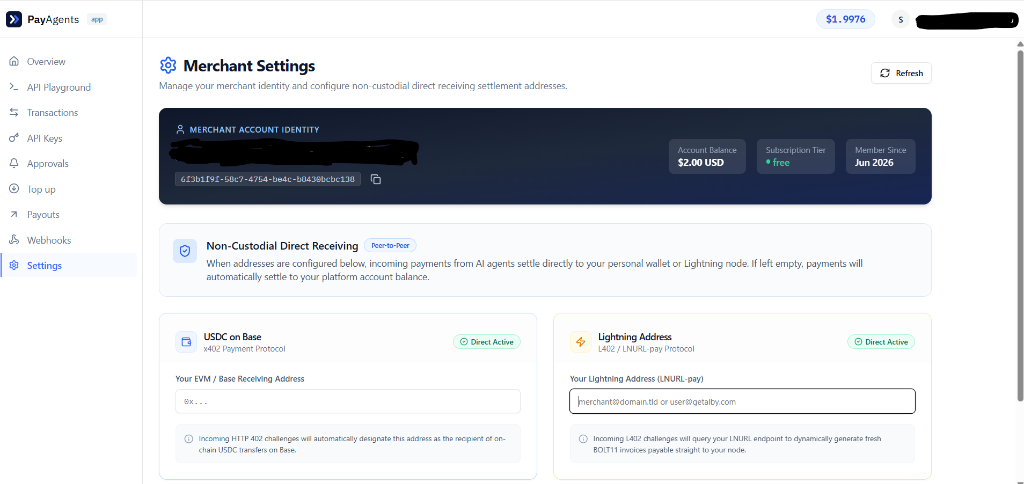
💡 Want platform-managed balance instead? Simply leave the address fields empty in Settings. When addresses are blank, funds will safely accumulate in your PayAgents USD balance ledger where you can configure automated withdrawal sweeps anytime.
5. Testing in the 402 API Playground
You can test your live non-custodial setup immediately without writing code:
- Open the 402 API Playground in your dashboard.
- Enter your API endpoint URL and click 1. Probe Challenge (402).
- Inspect the
WWW-Authenticateresponse header — you'll see your personal Base wallet address designated as the recipient. - Click 2. Execute POST /v1/pay to simulate an agent payment and watch funds land directly in your wallet!
6. Tracking Direct Settlements in Your Dashboard
Every transaction in PayAgents is completely transparent. On the Transactions page, any payment that settled directly to your wallet is clearly marked with an emerald Direct badge:
Settlement Mode: 🟢 Direct Non-Custodial Settlement
Destination: 0xb5d4cdd0c25ad6556714d8269846c0d406fba1e2
You can also use the Settlement Filter on the Transactions page to isolate all direct peer-to-peer transfers with a single click.
Conclusion
The future of AI agent commerce is peer-to-peer, automated, and non-custodial. By decoupling payment verification from fund custody, PayAgents gives you the best of both worlds: frictionless automated access for client agents and absolute control over your revenues.
Set Up Direct Non-Custodial Receiving
Create your free PayAgents merchant account and start receiving instant micropayments directly into your personal wallet.